
By Zhou Yueming
Amid the wave of Chinese brands going global, a new generation of smart hardware companies is emerging, specializing in innovative products with prices ranging from a few hundred to several thousand dollars that can compete on both price and quality with their Western counterparts. The smart litter box is a prime example, with a global market size of roughly $1 billion in 2024 and projected annual growth of 10% to 13% over the next few years.
Catlink, founded by Zhang Xiaolin in 2017, was an early pioneer in this niche. After launching its first product in 2019 in China, the company now operates in 119 countries and regions, serving over 1 million cats.
However, Catlink was also among the first to feel the heat of intensifying competition. As its technology was replicated and white-label manufacturers in Shenzhen and Dongguan flooded the market, similar products appeared on cross-border e-commerce platforms for $200 to $300 — half of Catlink’s price — putting a severe squeeze on profit margins.
‘Help cats live a year longer’
To survive, the company needed to change its business model. Rather than getting revenue from one-off sales of machines, Catlink turned itself into a long-term service provider, differentiating itself through core technology and a comprehensive after-sales experience. The goal became: “help cats live a year longer.”
Zhang was already involved in the cat litter box industry before he set up Catlink, heading a Chinese distributor for a major U.S. brand. But the product, priced at over 4,000 yuan ($580), was designed for larger homes with plumbing connections, ill-suited for smaller apartments in China, where a regular litter box cost just 20 yuan to 30 yuan. Seeing a market opportunity, he struck out on his own.
From the outset, the product had to serve both Chinese and global markets. To avoid customizing hardware for each country, Catlink built IoT connectivity into its litter boxes, allowing a single device to be controlled via a locally adaptable app. Crucially, it replaced the infrared sensors used by competitors with advanced weight-sensor technology. This allowed for precise identification of multiple cats and enabled health monitoring — a feature set that was at least five years ahead of the industry.
Launched in 2019, the first Catlink smart litter box was priced under 2,000 yuan in China, about one-third the cost of a similar American product and racked up 10 million yuan in sales in its first four months. International expansion began in 2020, and overseas revenue now accounts for nearly 50% of the total.
Going global step by step
Catlink adopted three distinct strategies in its “going global” expansion.
First was Southeast Asia. To minimize risk, it partnered with exclusive local agents, giving them pricing control while the head office provided technical support. To combat the problem of cheap cross-border goods undercutting local agents, Catlink implemented a technical solution: each device was locked to a specific region via its MAC address. Only units sold through official channels could access core features like health monitoring, thus protecting the premium pricing model.
Next came Japan and Korea. Viewed as mature markets resembling the U.S. and Europe, success here was seen as a validation of product quality. Again, using exclusive agents, Catlink gave them even greater autonomy in local marketing, while maintaining a price point of around 4,000 yuan.
The toughest nut to crack was North America. Initial attempts to secure a major offline distributor like Petco or Walmart proved slow and difficult. After efforts to build a cross-border e-commerce team in Shanghai failed, the company changed tack. It set up a dedicated office in Shenzhen focused entirely on a store on Amazon. The strategy worked. With its superior IoT features and attractive design priced at $499, often discounted to $399, Catlink outperformed local competitors stuck on older technology. By 2023, it became the best-selling smart litter box on Amazon in North America.
The crisis: white-label onslaught and price wars
By 2023, Catlink appeared to be a resounding success story. But the market dynamics shifted violently as a flood of white-label products from southern Chinese factories, replicating its core technology entered the global market. In the U.S., prices plummeted to $299 and even $199. These sellers, often operating multiple storefronts with little regard for after-sales service, forced a brutal price war. At the same time, established U.S. brands began adding smart features to counter the threat.
Catlink was hit hard — overseas growth slowed, and profits shrank. In a market where penetration was still low but prices were already being driven down, it had to find a new path forward.
Fighting back: a three-pronged offensive
Zhang’s response was multi-faceted.
First, he re-framed the threat of white-label brands, viewing them as “penetration educators.” By drawing in first-time buyers with low-cost electric boxes, they had expanded the overall market but when users inevitably encountered quality or service issues, they would seek out a reliable brand like Catlink.
Second, on Amazon, the goal shifted from being number one to generating profit. Instead of burning cash on advertising to defend the top spot against $199 competitors, Catlink switched its focus to maintaining a reasonable ranking and healthy margins. Marketing budgets were redirected to longer-term brand building on independent sites, YouTube, and social media.
The most significant move was a new “Heaven and Earth” product strategy:
- The “Earth” product, dubbed Fat Treasure, is an entry-level device priced to compete directly with white labels. In the U.S., it sells for $199, offering reliable basic smart functions for first-time cat owners, but with superior build quality and service.
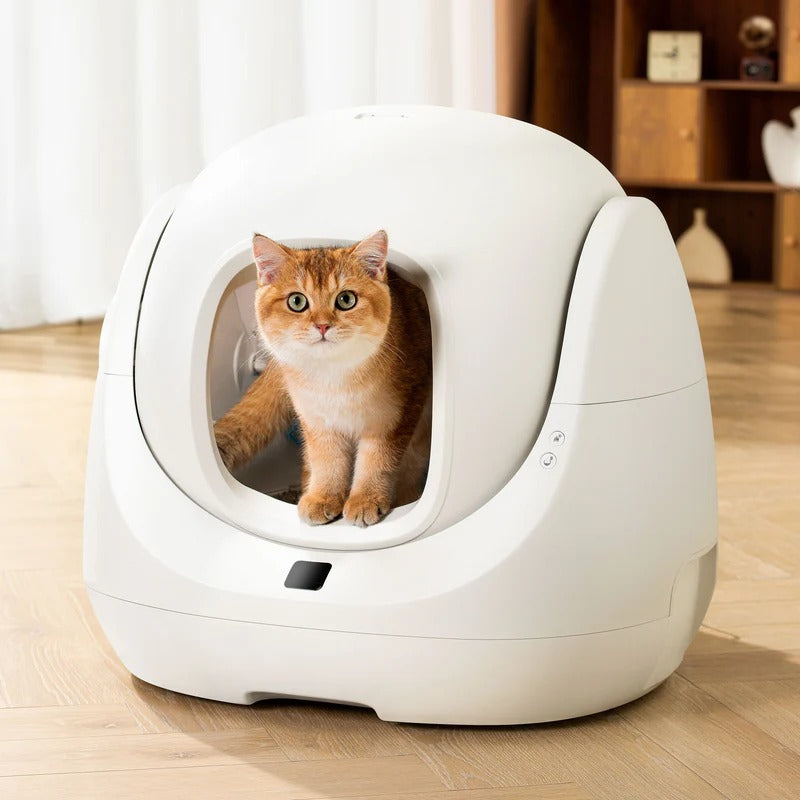
- The “Heaven” product, dubbed Big White, is a high-end device with advanced technology and smart features such as auto-refill, dual cameras for cat facial recognition and stool analysis to detect early diabetes risks, and an air purification system.
With this new product cycle, Zhang projects Catlink’s revenue will triple or quadruple in 2026 to more than 400 million yuan, with half coming from these two new models.