

By Brent Li
Guangfan Technology, a Chinese artificial intelligence startup, has secured nearly 300 million yuan ($42 million) in seed funding to develop AI-powered wearable devices, drawing investment from major industry players as it seeks to challenge global tech giants in the next era of computing.
The recent Seed++ and Seed+++ funding rounds were co-led by Lenovo Capital and Starquest Capital, an investment firm backed by electric vehicle maker Xpeng. Hong Kong-based venture capital firms Brizan Ventures and ForeBright also participated. The startup, which now commands a valuation of nearly 1 billion yuan, has also received backing from major Chinese hardware supply chain players including open-ear headphone maker Shokz, acoustics manufacturer Goertek, along with investment affiliates of battery giant CATL and semiconductor firm GigaDevice.
A standalone AI assistant
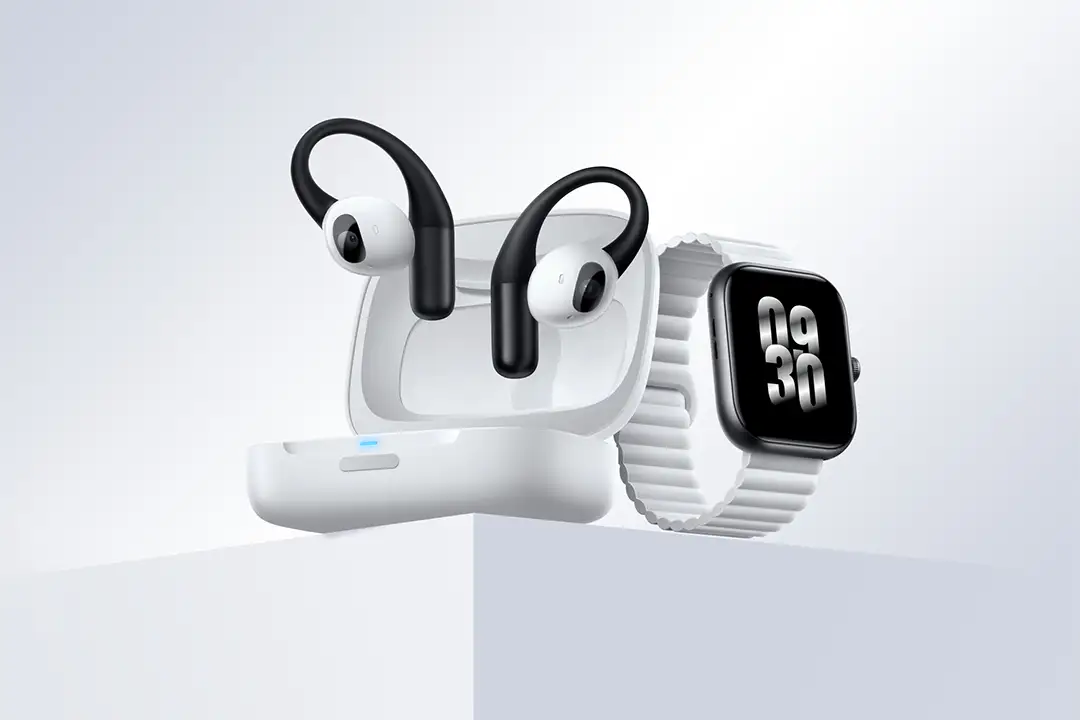
Unveiled in late December 2025 and showcased at the technology trade show CES 2026, Guangfan’s flagship product is the Lightwear AI system — a wearable computing suite consisting of open-ear earbuds equipped with a camera, a smart charging case, and an accompanying smartwatch.
The product is designed to decouple computing from smartphones. The company says the earbuds, which weigh 11 grams each and are made from medical-grade liquid silicone, feature a 2-megapixel binocular vision perception module. The camera is not intended for photography but rather acts as a visual sensor allowing the AI assistant to “see” and understand the user’s environment in real time.
To achieve true independence from a smartphone, the Lightwear system relies on its smart charging case. The case functions as a miniature computing hub, packed with a 2,000 mAh battery, a built-in eSIM for independent 4G internet access, a high-precision GPS module, and a financial-grade fingerprint sensor for authorizing payments and ride-hailing services. The case also features an independent microphone and speaker, allowing users to interact with the AI assistant even when the earbuds are docked.
The third component, a smartwatch, provides a full-color touch display for visual confirmation of tasks — such as viewing a license plate number for a ride-hailing service — and tracks biometric data like heart rate, blood oxygen, and stress levels to help the AI assistant provide proactive suggestions.
Powering the hardware is Lightware OS, a proprietary native AI operating system. Rather than relying on a traditional graphical user interface, the OS is designed around multimodal interactions. It acts as a central hub that connects various large language models (LLMs), manages sensor data, and facilitates a third-party application ecosystem that operates entirely through voice and visual prompts.
Industry analysts estimate the product will be priced around the 2,000 yuan mark. While Guangfan has opened the product for pre-order ahead of its scheduled first-quarter release, all product specifications and capabilities are based on the company’s own claims. The device has not yet been subject to any real-world testing or reviews by independent third parties.
The Xiaomi brains behind Guangfan
Guangfan was founded in October 2024 by Dong Hongguang, a veteran software engineer who spent 14 years at Chinese consumer electronics giant Xiaomi. Joining the smartphone maker in 2010 as its 89th employee, Dong played a pivotal role in developing Xiaomi’s MIUI interface, its Quick Apps ecosystem, and later spearheaded the company’s proprietary smartphone and automotive operating systems.
Dong’s central premise for Guangfan is that smartphones are fundamentally unsuited to be the primary vessel for AI. Because they spend most of the time in pockets and require active, manual operation, they fail to provide the continuous, ambient environmental awareness that an AI assistant needs to be proactive.
“Every revolution in human-computer interaction brings a change in hardware form,” Dong said in a recent interview. He argues that in the AI era, interaction and computing will decouple. As complex computing shifts to cloud-based LLMs, the primary user terminal only needs to handle multimodal interactions — making wearables the ideal device format.
To execute this vision, Dong has built a team of over 100 employees including specialized talent such as a former consumer technology lead from Chinese AI unicorn MiniMax, who now directs Guangfan’s large model integration efforts.
A crowded arena of tech giants
Guangfan is entering a highly competitive and heavily capitalized arena, as tech behemoths worldwide race to define the post-smartphone era.
In the wearable audio space, ByteDance quietly launched its first AI earbud, the Ola friend, in October 2024. However, unlike Guangfan’s proposed standalone system, the device relies heavily on a Bluetooth connection to a smartphone and the company’s Doubao app to process complex AI tasks.
Silicon Valley is also mobilizing. Apple has steadily bolstered the independent capabilities of the Apple Watch and AirPods ecosystem, while reports suggest OpenAI is developing its own camera-equipped earbuds after recruiting former Apple design chief Jony Ive’s team. Meta, which has already found success with its Ray-Ban smart glasses, is reportedly developing a similar earbud concept, internally dubbed “Camerabuds.”
Other tech heavyweights like Google and Alibaba are placing their bets on smart glasses, but Dong remains skeptical of their current viability, citing issues with weight, battery life, and mainstream social acceptance. He notes that earbuds, which sell hundreds of millions of units annually, offer a much lower barrier to entry for consumers.
Despite the looming competition from companies with vastly superior resources, Dong believes Guangfan’s head start in hardware engineering and its purpose-built OS give it a fighting chance.
“Software companies and hardware companies operate on completely different logic,” Dong said, highlighting the difficulty internet companies face when attempting hardware manufacturing. “The ability to view problems from an integrated hardware-software perspective is extremely rare.”
Sources:
- 光帆科技完成近3亿元种子轮系列融资:产业巨头集体押注「AI赛道稀缺标的」
(https://mp.weixin.qq.com/s/5FByt1FRs1gMfu4I8TiL_Q) - OpenAI也在做带摄像头的耳机,我们更早|对话光帆科技董红光
(https://mp.weixin.qq.com/s/gO15ONy0l9ANc_y3-z8SuA) - 独家丨OpenAI、Meta都在押注的摄像头AI耳机,被这家中国明星创业公司抢先发布
(https://mp.weixin.qq.com/s/aCcVt9PL-TBzKGnOgRE1VA) - 光帆科技亮相 CES 2026:AI 穿戴的新形态正被世界看见
(https://mp.weixin.qq.com/s/cgS3tVKxJDy2TaL8kz7ngQ) - 光帆科技发布全球首款具备视觉感知能力的主动式AI耳机
(https://finance.sina.com.cn/roll/2025-12-25/doc-inhcznyf3403499.shtml?cre=tianyi&mod=pchp&loc=22&r=0&rfunc=41&tj=cxvertical_pc_hp&tr=12)